
What Is Bertolotti Syndrome and How Is It Diagnosed?
What Is Bertolotti Syndrome and How Is It Diagnosed?
At the office of Dr. Craig C. Callewart, MD, PA in Dallas, Forney, and Rockwall, TX, we evaluate spine-related pain with careful testing and a plan built around trust and clear communication. When low back pain starts early, lingers despite home care, or behaves differently than typical muscle strain, we consider less common causes, including Bertolotti syndrome.
What Bertolotti Syndrome Means
Bertolotti syndrome is a congenital condition occurs when a person has a transitional vertebra at the base of the spine, most often an enlarged lowest lumbar vertebra that partially connects with the sacrum or pelvis. That extra connection can change how forces move through the lower back and hips. Over time, it can overload nearby joints and discs and contribute to chronic pain.
Common Symptoms We See
Many patients describe low back pain that worsens with prolonged sitting, standing, or activity. Some feel pain to one side of the spine, near the belt line, or deep in the buttock. Others develop stiffness, reduced range of motion, or symptoms that mimic sacroiliac joint or disc pain. Dr. Callewart looks for patterns that suggest a structural contributor rather than a short-term strain.
How We Diagnose It
We start with a detailed history and a focused spine and neurologic exam. We ask when pain began, what triggers it, and whether it radiates, causes numbness, or limits walking and daily tasks. Dr. Callewart also evaluates posture, gait, flexibility, and specific movements that reproduce symptoms.
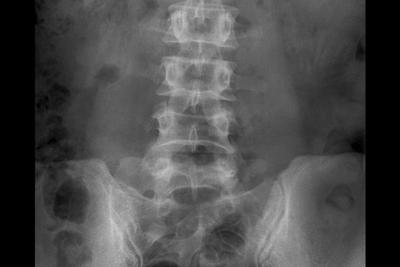
Imaging plays a key role. Plain X-rays can often show the transitional vertebra and any partial fusion or pseudo-joint. If symptoms suggest nerve irritation or disc involvement, we may recommend advanced imaging, such as MRI or CT, to evaluate discs, nerves, and surrounding joints. Dr. Callewart uses these findings to distinguish Bertolotti syndrome from other sources of persistent low back pain.
How We Confirm Source of Pain
Not every transitional vertebra causes symptoms, so we focus on confirming the pain generator. In some cases, targeted diagnostic injections help. If pain decreases significantly after an injection into the suspected joint or adjacent structure, that response supports the diagnosis and guides next-step treatment.
What Happens After Diagnosis
Once we confirm the cause, we may recommend a combination of activity modification, physical therapy focused on mechanics and core stability, anti-inflammatory strategies, and image-guided injections when appropriate. If conservative care fails and imaging shows a clear pain source, we discuss additional options based on your anatomy and goals.
Schedule a Spine Evaluation With Our Team
If you suspect Bertolotti syndrome or you live with ongoing low back pain, we can help you get clear answers. Contact the office of Dr. Craig C. Callewart, MD, PA in Dallas, Forney, and Rockwall, TX, at (214) 271-4585 to schedule an evaluation and review the right diagnostic plan for your symptoms.
What Is Bertolotti Syndrome and How Is It Diagnosed?
At the office of Dr. Craig C. Callewart, MD, PA in Dallas, Forney, and Rockwall, TX, we evaluate spine-related pain with careful testing and a plan built around trust and clear communication. When low back pain starts early, lingers despite home care, or behaves differently than typical muscle strain, we consider less common causes, including Bertolotti syndrome.
What Bertolotti Syndrome Means
Bertolotti syndrome is a congenital condition occurs when a person has a transitional vertebra at the base of the spine, most often an enlarged lowest lumbar vertebra that partially connects with the sacrum or pelvis. That extra connection can change how forces move through the lower back and hips. Over time, it can overload nearby joints and discs and contribute to chronic pain.
Common Symptoms We See
Many patients describe low back pain that worsens with prolonged sitting, standing, or activity. Some feel pain to one side of the spine, near the belt line, or deep in the buttock. Others develop stiffness, reduced range of motion, or symptoms that mimic sacroiliac joint or disc pain. Dr. Callewart looks for patterns that suggest a structural contributor rather than a short-term strain.
How We Diagnose It
We start with a detailed history and a focused spine and neurologic exam. We ask when pain began, what triggers it, and whether it radiates, causes numbness, or limits walking and daily tasks. Dr. Callewart also evaluates posture, gait, flexibility, and specific movements that reproduce symptoms.
Imaging plays a key role. Plain X-rays can often show the transitional vertebra and any partial fusion or pseudo-joint. If symptoms suggest nerve irritation or disc involvement, we may recommend advanced imaging, such as MRI or CT, to evaluate discs, nerves, and surrounding joints. Dr. Callewart uses these findings to distinguish Bertolotti syndrome from other sources of persistent low back pain.
How We Confirm Source of Pain
Not every transitional vertebra causes symptoms, so we focus on confirming the pain generator. In some cases, targeted diagnostic injections help. If pain decreases significantly after an injection into the suspected joint or adjacent structure, that response supports the diagnosis and guides next-step treatment.
What Happens After Diagnosis
Once we confirm the cause, we may recommend a combination of activity modification, physical therapy focused on mechanics and core stability, anti-inflammatory strategies, and image-guided injections when appropriate. If conservative care fails and imaging shows a clear pain source, we discuss additional options based on your anatomy and goals.
Schedule a Spine Evaluation With Our Team
If you suspect Bertolotti syndrome or you live with ongoing low back pain, we can help you get clear answers. Contact the office of Dr. Craig C. Callewart, MD, PA in Dallas, Forney, and Rockwall, TX, at (214) 271-4585 to schedule an evaluation and review the right diagnostic plan for your symptoms.
Are You In Pain?
Most patients experiencing pain can be seen by Dr. Callewart or his physician assistant within 24 hours in Dallas, Forney and Rockwall, Texas.
Our Locations
Office Hours
Monday
8:00 am - 5:00 pm
Tuesday
8:00 am - 5:00 pm
Wednesday
8:00 am - 5:00 pm
Thursday
8:00 am - 5:00 pm
Friday
8:00 am - 5:00 pm
Saturday
Closed
Sunday
Closed